
When a General Contractor Defaults: How Payment and Performance Bonds Helped Rescue a Georgia Commercial Project
By Mark A. Cobb | Cobb Law Group
A commercial construction project can deteriorate with remarkable speed when its general contractor becomes financially distressed. The owner may have paid millions of dollars under approved pay applications, yet, he may find that the subcontractors and suppliers whose work generated those payments have not been compensated. What initially appears to be an isolated payment dispute can become a project-wide financial crisis, with liens encumbering the real estate, work slowing, and completion itself in jeopardy.
Cobb Law Group represented the owner of a substantial commercial construction project confronting precisely that predicament. The general contractor had encountered difficulties on other jobs and was using receipts from this project to satisfy overdue obligations elsewhere. As a result, subcontractors and material suppliers working on the owner’s building were not being paid. Their claims multiplied, and eventually more than $3 million in materialmen’s liens were recorded against the property.
The owner ultimately had to declare the general contractor in default and invoke the performance bond. Meanwhile, unpaid subcontractors and suppliers looked to the payment bond. The building was eventually completed. The experience illustrates why those two instruments, although frequently issued together, address fundamentally different risks.
The Financial Distress Behind the Liens
General contractors often operate several projects simultaneously, and the use of centralized accounting systems is not inherently unlawful. Georgia law does not automatically convert every progress payment into trust property dedicated exclusively to a particular subcontractor. The practical danger arises when a contractor depends upon money earned on one job to satisfy delinquent obligations on another, leaving insufficient resources to pay for the work presently being performed. That was the pattern that emerged in this matter. Payments flowed from the owner to the general contractor, but they did not consistently reach the companies supplying labor and materials to the project. Suppliers complained about aging receivables; subcontractors questioned whether they could continue working; and lien filings began to appear in the county records. The first filing might have represented an ordinary dispute. The succession of claims, ultimately exceeding $3 million, disclosed a more pervasive problem.
Of course, it is without saying that an owner should not assume that every recorded lien is valid or that its face amount represents a debt ultimately enforceable against the property. In fact, in this matter, we were about to void liens due to technical difficulties including the lien claimants failure to comply with Georgia’s Statutory Notice Scheme. Nevertheless, liens complicate construction financing, loan conversions, refinancing, sales, and title insurance. They can also place the owner in the particularly disagreeable position of having paid its contractor while facing claims from parties with whom it never contracted.
Why Georgia Materialmen’s Liens Matter to Owners
Georgia’s lien framework, beginning with O.C.G.A. § 44-14-361, grants qualifying construction participants statutory security against improved real estate. The procedures for recording and enforcing claims appear principally in O.C.G.A. § 44-14-361.1. A claimant ordinarily must record its lien within the statutory 90-day period following its last qualifying work or furnishing of materials, and additional enforcement requirements apply. The following is very important to remember:
A lien is not a personal contractual claim against the owner merely because the owner owns the improved property. Rather, it is a statutory remedy against the property, subject to important limitations and defenses, including provisions concerning owner payments and the amount properly chargeable to the improvement. The distinction is consequential: the recording of a lien creates an encumbrance, but it does not adjudicate its validity.
Each claim therefore requires independent investigation. Counsel should review contracts, purchase orders, invoices, delivery tickets, payment applications, lien waivers, notices, and the recording history. The owner should also examine overlapping claims. A subcontractor may assert an unpaid contract balance that includes materials for which its supplier separately claims a lien. Adding the two amounts without reconciliation can substantially overstate the economic exposure.
For related analysis, see Cobb Law Group’s discussion of liens and commercial collections and its guide to liens and bond claims.
Two Bonds, Two Different Protections
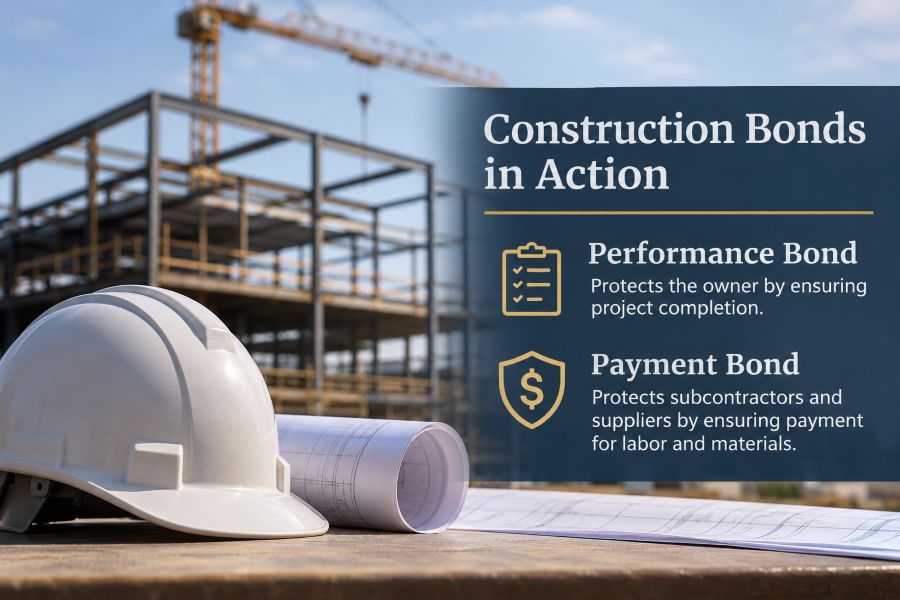
The payment bond and performance bond were central to the project’s eventual resolution. Both involved the general contractor as principal and a surety undertaking defined contractual obligations. Their beneficiaries and purposes, however, differed.
A payment bond supplies qualifying subcontractors, suppliers, and other covered claimants with a potential source of recovery for unpaid labor and materials. A performance bond protects the owner, as obligee, against the bonded contractor’s covered failure to perform the construction contract. Put simply, one addresses payment to project participants; the other addresses performance owed to the owner.
The distinction is reflected in the American Institute of Architects’ guidance for A312 payment and performance bonds. The actual instrument, rather than a general description of suretyship, controls the parties’ rights. The surety’s obligations are not necessarily coextensive with every loss the owner or an unpaid supplier might experience.
On privately owned projects, payment-bond coverage and claim procedures generally depend heavily upon the bond’s language and applicable law. Public projects involve statutory schemes, including Georgia’s public construction bond provisions and the federal Miller Act, 40 U.S.C. §§ 3131–3134. Ordinary materialmen’s liens generally cannot attach to public property, making statutory payment-bond remedies especially significant there.
Cobb Law Group has separately examined payment bonds on privately owned Georgia projects and surety bonding in Georgia.
When the Owner Declares Default
Financial weakness does not invariably constitute contractual default. The critical question is whether the contractor has materially failed to perform obligations imposed by the construction contract. Commercial agreements commonly require the contractor to pay its subcontractors and suppliers, maintain progress, furnish appropriate waivers, and protect the property against liens attributable to its nonpayment.
In this matter, the continued nonpayment, growing lien exposure, and uncertainty surrounding the contractor’s ability to complete the building made continued performance under the existing arrangement untenable. The owner invoked the contract’s default provisions and pursued relief under the performance bond.
That step required particular care. A termination letter should not be drafted in isolation from the bond. Widely used forms, including AIA A312-2010, prescribe notice and default procedures and reserve specified response options to the surety. Premature replacement of the contractor or failure to comply with applicable conditions can generate defenses to an otherwise substantial bond claim.
The owner must examine the contract, cure provisions, notice requirements, available contract funds, and the bond’s conditions before acting. The firm’s construction litigation practice addresses the broader disputes that arise from termination, delay, and contractor default.
How a Performance-Bond Surety Can Complete the Project
Once a covered default is asserted, the surety ordinarily investigates rather than simply tendering the penal sum. Its review may encompass the remaining scope of work, defective construction, approved and disputed change orders, contract payments, retainage, schedules, subcontractor balances, and the contractor’s capacity to continue. The remaining contract balance is especially important because many bonds contemplate that the owner will make those funds available toward completion.
- One possible response is to support the original contractor financially and supervise its completion. That approach preserves continuity, but it is difficult to justify when the contractor’s financial problems are systemic and additional advances might merely finance losses elsewhere.
- A second alternative is a takeover arrangement under which the surety assumes responsibility for organizing completion, commonly through a construction manager or replacement general contractor. The takeover agreement must address scope, existing defects, contract funds, warranties, scheduling, subcontractor continuity, and the treatment of outstanding claims.
- Third, the surety may tender a replacement contractor and arrange for a completion contract consistent with the bond. The owner must scrutinize the replacement contractor’s qualifications, financial capacity, proposed schedule, and treatment of work performed by its predecessor. A new contractor understandably resists assuming unlimited responsibility for unknown defects in existing construction.
- Fourth, where the bond permits, the surety may resolve its obligation through payment of the covered loss, leaving the owner to arrange completion. This option requires a defensible estimate of remaining work and covered damages. Settling prematurely can leave the owner exposed if hidden defects or incomplete work make completion materially more expensive than expected.
The surety may also deny liability based upon the bond or the facts. Such a denial is not a completion option; it is a contested position that may lead to litigation. The proper course depends on the specific instrument and circumstances, not on an abstract assumption that every surety must choose the same remedy.
The Remaining Contract Balance and the Risk of Double Recovery
Consider a hypothetical $25 million contract under which the owner has paid $20 million at default. The nominal unpaid balance is $5 million. If completion reasonably costs $7 million, a potential $2 million shortfall arises before considering covered delay losses, defective work, or other adjustments. That arithmetic is useful, but it does not establish the surety’s liability without examining the bond and contract.
Nor does the existence of $3 million in recorded liens automatically add $3 million to the performance-bond claim. Some claims may be disputed or duplicative; some may fall within the payment bond; and some obligations may already be reflected in the completion contractor’s price. The owner, surety, and completion contractor must reconcile these amounts to avoid double payment or duplicate recovery.
Accurate contract accounting is therefore indispensable. The parties should establish the status of retainage, unpaid applications, change orders, direct payments, bond settlements, and remaining completion costs. The exercise is often as important as the legal declaration of default itself.
How Payment-Bond Claims Help Resolve the Liens
While the performance bond addressed the unfinished building, the payment bond afforded qualifying subcontractors and suppliers an avenue for collecting covered unpaid accounts. The surety typically investigates contracts, invoices, delivery records, payment histories, and asserted defenses before determining whether and in what amount a claim should be paid.
On a private project, the claimant may have both a bond remedy and a materialmen’s lien remedy. Those rights are separate. A payment-bond claim runs against the principal and surety under the bond; a lien is a statutory claim against the improved property. The claimant may pursue available remedies but cannot collect the same debt twice.
Payment of a bond claim does not, by itself, necessarily remove a recorded lien. A settlement should therefore require an appropriate lien release or cancellation, and the owner should confirm that the necessary instrument is recorded. Where a lien is disputed, O.C.G.A. § 44-14-364 provides a mechanism for discharging certain liens through substitute security. A lien-discharge bond is not the same instrument as the contractor’s original payment bond.
Coordinating settlements is especially important where the completion contractor intends to retain an unpaid subcontractor. Past-due amounts, new work, lien releases, and payment-bond proceeds must be allocated carefully. Otherwise, an owner may finance the same work twice or obtain a completed building with unresolved title defects.
Georgia’s statutory lien waiver provisions, O.C.G.A. § 44-14-366, also warrant attention. The effect of a waiver depends upon the applicable statutory form, timing, payment, and surrounding facts and can impact the amounts claimed in both a lien and a payment bond.
The Practical Difficulties of Completion
Completing another contractor’s project is rarely a matter of hiring a new firm and resuming work the following morning. The replacement contractor must verify quantities, inspect work already performed, locate project records, assess defective or incomplete construction, and determine which subcontractors remain willing and able to perform.
Off-site materials can create additional disputes over ownership, identification, payment, and security interests. Existing subcontractors may demand assurance that past-due balances will be addressed before remobilizing. Warranty responsibilities must be divided between predefault and postdefault work, and the parties must account for inspections, commissioning, closeout documentation, and potential latent defects.
Delay costs require equal care. Extended financing, professional fees, carrying expenses, and lost revenue may be substantial, but their recoverability depends upon the construction contract, bond language, causation, and applicable limitations. Contemporaneous schedules, correspondence, and financial records should be preserved from the first indication of serious distress.
The Project Was Completed: Lessons for Georgia Construction Participants
Despite the contractor’s financial deterioration and the liens exceeding $3 million, the commercial project was ultimately completed. The significance of that outcome is not that surety bonds eliminate every consequence of contractor default. They do not. Rather, the bonds provided separate contractual frameworks for addressing the owner’s completion needs and the unpaid participants’ payment claims.
Owners and developers should evaluate bonding at contract formation, monitor subcontractor payment information during performance, investigate lien filings promptly, and avoid terminating a bonded contractor without reviewing the bond’s conditions. The remaining contract balance should be preserved and accounted for with particular care.
Subcontractors and suppliers should obtain bond information early, understand their claim and notice requirements, and preserve independent lien rights where available. A contractor’s assurance that payment will follow the next draw does not necessarily extend a statutory deadline. See the firm’s guide to payment and lien remedies.
General contractors should recognize that chronic nonpayment can produce far more than collection lawsuits. Bond claims and completion expenses may ultimately give rise to indemnity exposure under agreements executed with the surety, potentially implicating affiliated entities or individual indemnitors.
For the owner in this matter, the legal problem was not simply how to remove liens or how to terminate a contractor. It was how to preserve the project’s value, establish a workable completion path, and coordinate competing rights without paying twice for the same construction. Those tasks require a coherent strategy grounded in the contract documents, Georgia lien law, and the distinct obligations undertaken in each bond.
Cobb Law Group: Georgia Construction Bond and Lien Counsel
Cobb Law Group represents commercial property owners, developers, contractors, subcontractors, and suppliers in Georgia construction disputes, including contractor defaults, payment-bond claims, performance-bond disputes, materialmen’s liens, and construction litigation. Learn more about Mark A. Cobb and the firm’s construction law publications.
This article is for general information, not legal advice. Identifying details of the matter have been omitted. The applicable rights depend upon the particular contracts, bond instruments, facts, and governing law.