
Georgia Multifamily Developers Face a New Challenge: Rising Costs, Unpaid Subcontractors, and Millions in Construction Liens
GEORGIA CONSTRUCTION LAW | MULTIFAMILY DEVELOPMENT | OCTOBER 2026
How Apartment Owners and Real Estate Developers can Protect their Investments when Construction Projects Encounter Financial Trouble

Georgia’s multifamily housing industry has experienced remarkable growth over the past decade. From large apartment developments throughout metropolitan Atlanta to expanding residential communities in Savannah, Augusta, Columbus, and other Georgia markets, developers have invested billions of dollars in new housing.
But for many apartment owners and developers, the financial realities of 2026 have created a difficult environment.
Higher financing costs, construction cost escalation, slower-than-anticipated rent growth, and increased operating expenses have placed significant pressure on multifamily projects. Some developers are discovering that their financial difficulties extend beyond the traditional challenges of construction and leasing.
One particularly troubling situation occurs when an apartment developer pays its general contractor, only to discover that the contractor has failed to pay the subcontractors and material suppliers who actually performed the work. The result can be devastating. Subcontractors and suppliers may record hundreds of thousands—or even millions—of dollars in mechanics’ and materialmen’s liens against the property. Those liens can interfere with refinancing, permanent loan conversions, property sales, and the owner’s ability to complete or stabilize the development.
At Cobb Law Group, our Georgia construction attorneys understand these problems from both sides of the construction contract. We represent project owners, developers, general contractors, subcontractors, and material suppliers in sophisticated construction disputes throughout Georgia. For multifamily owners and developers, early legal intervention can make a substantial difference in protecting a project’s equity, financing, and long-term profitability.
Georgia’s Multifamily Market: Economic Pressure Meets Construction Risk
The challenges facing apartment developers are not merely anecdotal.
According to the National Association of Home Builders, multifamily construction continues to face tighter financing conditions and elevated construction costs. The association forecast a decline in multifamily housing starts during 2026, reflecting a more constrained development environment.
Meanwhile, CBRE’s 2026 U.S. Multifamily Outlook identifies several continuing challenges, including financing costs, slower rent growth, and the lingering effects of substantial new apartment supply in Sun Belt markets.
Atlanta provides an instructive example.
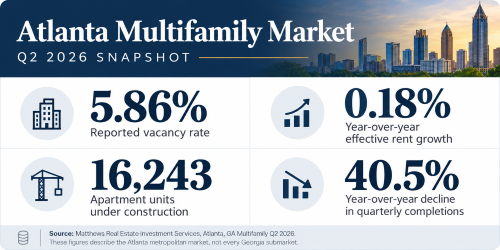
Year-over-year decline in quarterly completions Source: Matthews Real Estate Investment Services, Q2 2026.
These figures describe the Atlanta metropolitan market, not every Georgia submarket.
There are encouraging signs. Recent market research indicates that Atlanta’s apartment vacancy has begun declining and that the construction pipeline has contracted. However, a recovering market does not immediately solve the problems facing developments financed or constructed under earlier economic assumptions.
A project originally underwritten with lower borrowing costs, stronger rent growth, and a shorter construction schedule may now face substantially different financial conditions.
And when financial pressure affects the general contractor, the consequences can spread throughout the project.
When the General Contractor Gets Paid but the Subcontractors Do Not
Consider a situation that is becoming increasingly important for multifamily owners.
A developer enters into a construction contract for a $40 million apartment complex. Over the course of construction, the developer makes substantial progress payments to the general contractor. The contractor submits payment applications reflecting work performed by electricians, plumbers, HVAC contractors, framing subcontractors, and numerous material suppliers.
The developer reasonably expects those payments to flow downstream to the companies furnishing labor and materials.
But what happens if they do not?
Perhaps the contractor has experienced cash-flow problems on other projects. Perhaps construction costs exceeded its estimates. Or perhaps funds received for one project were used to satisfy obligations elsewhere.
Whatever the reason, subcontractors and suppliers begin reporting unpaid invoices.
Soon, the developer receives notices that materialmen’s liens have been filed against the apartment complex.
A project that appeared to be approaching successful completion is suddenly burdened by millions of dollars in recorded lien claims. Worse, the owner may have already paid the general contractor for much of the work underlying those claims. The owner now faces the possibility of paying twice for the same improvements.
This is precisely the type of dispute in which experienced Georgia construction counsel can provide substantial value.
Why Materialmen’s Liens Are Particularly Dangerous for Apartment Developers
Under Georgia law, qualifying contractors, subcontractors, and material suppliers may acquire lien rights against improved real estate when they have not been paid. These rights are governed principally by O.C.G.A. §§ 44-14-361 and 44-14-361.1. A lien is not automatically valid merely because it has been recorded. Georgia imposes detailed statutory requirements concerning deadlines, notices, the underlying claim, and enforcement. Nevertheless, even a disputed lien can create immediate practical problems for an apartment developer.
1. Refinancing and permanent financing may be delayed
Many multifamily developments depend upon converting construction financing into permanent financing after completion and stabilization. Recorded construction liens can complicate that process. A construction lender or permanent lender may require satisfactory resolution of outstanding liens before advancing additional funds or closing a refinancing transaction.
2. Property sales may become more difficult
An owner planning to sell a completed apartment development may discover that unresolved lien claims create title exceptions that must be addressed before closing. A substantial lien dispute can delay a transaction, complicate negotiations, or require escrow arrangements and other protections.
3. Construction may come to a halt
Unpaid subcontractors may stop performing work, decline to return to the project, or refuse to provide additional materials. If the general contractor is unable or unwilling to resolve the payment problems, the owner may be forced to consider termination, replacement contractors, or direct arrangements with critical trades.
4. The owner may face substantial additional costs
Beyond the lien claims themselves, the developer may incur additional financing costs, legal expenses, construction delays, lost rental revenue, and increased completion costs. These losses can quickly exceed the amounts originally in dispute. For apartment owners operating under tight financing and leasing projections, time is often as important as money.
Can a Georgia Apartment Owner Challenge a Materialmen’s Lien?
Yes. Georgia law provides several potential defenses and remedies, although their availability depends upon the particular facts and statutory requirements.
A properly prepared lien analysis may reveal defects involving the claimant’s statutory eligibility, filing deadlines, required notices, amount claimed, property identification, or compliance with other lien requirements.
For example, Georgia generally requires a qualifying lien claimant to record its claim within 90 days after completing the relevant work or furnishing the relevant materials. Additional deadlines apply to enforcement of the lien. The statute also imposes specific requirements concerning the contents of the lien and notice to the property owner. In some circumstances, an owner may use Georgia’s statutory notice-of-contest procedure to accelerate the period within which a lien claimant must pursue enforcement.
Other remedies may include negotiated releases, litigation challenging lien enforceability, or substituting security for the property through an appropriate lien-discharge bond. However, there is no single strategy that works for every lien. A project with 15 lien claimants may present 15 different legal and factual questions.
Cobb Law Group regularly handles the legal issues involved in contesting Georgia materialmen’s liens using all of the legal tools available. Our objective is not simply to identify potential technical defenses. It is to develop a practical strategy that protects the owner’s property while accounting for construction completion, lender requirements, litigation exposure, and business objectives.
The Importance of Reviewing the General Contractor’s Payment Applications
When a multifamily development experiences widespread subcontractor nonpayment, one of the first priorities should be reconstructing the project’s payment history. That analysis may involve reviewing the original construction agreement, payment applications, schedules of values, lien waivers, subcontractor payment records, retainage, and communications among the parties. Particular attention should be given to whether the general contractor represented that subcontractors had been paid when they had not. The analysis may reveal important differences between the amounts the owner paid, the amounts the contractor was entitled to receive, and the amounts actually distributed to subcontractors.
Depending upon the circumstances, the owner may have claims for breach of contract, indemnification, misrepresentation, or other relief.
For projects utilizing AIA construction agreements, the payment certification process, contractual representations, notice requirements, and termination provisions may be especially important.
A developer should not assume that the existence of a lien means the owner must simply pay the claimant. Nor should the owner assume that payment to the general contractor automatically eliminates every subcontractor’s lien rights. The contractual documents and Georgia’s statutory lien framework must be examined together.
What Happens When a General Contractor Cannot Finish the Apartment Project?
Subcontractor nonpayment sometimes signals a larger problem: the general contractor may no longer have the financial resources to complete the project. This creates difficult decisions for owners.
Terminating a contractor too quickly can create additional contractual liability. Waiting too long can allow the project’s financial condition to deteriorate further.
Before taking action, an owner should evaluate the contract’s default and termination provisions, applicable notice and cure requirements, available retainage, completion costs, surety protections, and the status of outstanding subcontractor obligations.
A coordinated legal and financial strategy may allow the developer to preserve important claims while keeping construction moving. For example, negotiated arrangements with critical subcontractors may help avoid substantial delays. But direct payments, joint checks, or replacement agreements must be structured carefully to avoid duplicate payment obligations and unintended waivers of contractual rights.
Where a performance bond or other applicable surety protection exists, its terms and notice requirements should also be evaluated promptly.
Cobb Law Group’s experience with construction payment and surety bond disputes can be particularly useful when a troubled project involves multiple contractual relationships.
Construction Cost Escalation and Change Order Disputes
Not every financial dispute on a multifamily project begins with unpaid subcontractors. Rising material costs, labor shortages, unforeseen site conditions, and schedule disruptions can produce substantial disagreements over the final construction price. Owners may receive unexpected change order requests late in construction. General contractors may contend that the original contract price no longer reflects the actual cost of completing the work.
Disputes frequently arise over whether a particular cost was included in the original scope, whether a change was properly authorized, or which party assumed the risk of escalation.
These questions are particularly significant under guaranteed maximum price contracts. A properly negotiated GMP agreement can provide meaningful protections, but its effectiveness depends upon the actual contract language, allowances, contingencies, change order provisions, and administration of the project. Experienced construction counsel can help determine whether additional compensation is legally justified and whether the contractor has complied with the contractual requirements for asserting a claim.
Five Steps Georgia Multifamily Owners Should Take When Payment Problems Appear
When a developer learns that subcontractors have not been paid, the response should be prompt and coordinated.
1. Obtain a complete accounting of construction payments.
Identify amounts paid to the general contractor, outstanding payment applications, retainage, and amounts reportedly owed to subcontractors and suppliers.
2. Inventory and evaluate all lien claims.
Create a centralized record of lien claimants, claimed amounts, recording dates, alleged last dates of work, statutory notices, and enforcement deadlines.
3. Preserve contractual and statutory rights.
Review default provisions, indemnification rights, lien protections, insurance, surety bonds, and applicable notice requirements before taking action.
4. Coordinate with the construction lender and title insurer.
Determine which lien issues affect upcoming draws, refinancing, or sales, and whether acceptable security or other arrangements can address them.
5. Engage experienced Georgia construction counsel.
Develop a unified strategy rather than negotiating each claim in isolation without understanding its effect on the broader project. Owners should also exercise caution before withholding payments, terminating a contractor, or making direct payments to subcontractors. Those decisions may be governed by contractual provisions and Georgia’s payment laws. For additional information, see Cobb Law Group’s discussion of the Georgia Prompt Payment Act.
Preventing the Next Crisis: Better Contracts and Better Payment Controls
Although legal counsel is frequently called after a project encounters financial difficulty, some of the most valuable legal work occurs before construction begins.
Apartment developers can reduce risk through carefully drafted construction agreements and effective payment procedures.
These protections may include appropriately structured lien waivers, subcontractor payment verification, joint-check procedures, retainage provisions, payment security, and contractual rights to obtain financial information when payment problems arise.
Georgia’s statutory Notice of Commencement requirements also deserve careful attention. A properly prepared and recorded notice can affect the statutory notice obligations of certain subcontractors and suppliers and help owners identify potential claimants. Cobb Law Group
It is also important to use the correct statutory lien waiver forms and understand their legal consequences.
An effective construction contract should do more than establish a price and completion date. It should provide mechanisms for identifying payment problems before they become multimillion-dollar disputes.
Why Multifamily Developers Need Construction Counsel Who Understands the Entire Project
Large apartment developments present legal challenges that differ significantly from those associated with a single residence or small commercial building. A multifamily development may involve dozens of subcontractors, substantial financing obligations, multiple buildings or phases, complex ownership structures, and contractual relationships involving developers, lenders, contractors, architects, and suppliers.
When a dispute arises, its consequences can extend far beyond the immediate construction contract. An unresolved lien can affect financing. A financing delay can affect construction completion. Delayed completion can affect leasing, cash flow, and the ultimate value of the investment.
Addressing these interconnected problems requires more than a narrow review of an individual lien claim. It requires an understanding of Georgia construction law and the commercial realities of real estate development.
How Cobb Law Group Helps Georgia Apartment Owners and Developers
Cobb Law Group concentrates its practice on construction-related legal matters throughout Georgia from its two physical locations in Atlanta and South Georgia.
Our attorneys have substantial experience with mechanics’ and materialmen’s liens, construction payment disputes, payment bonds, and construction litigation.
Importantly, our work on behalf of owners, contractors, subcontractors, and suppliers provides insight into how construction payment disputes develop and how different parties approach their resolution.
For apartment developers and multifamily property owners, we can assist with evaluating and contesting liens, reviewing construction contracts, investigating subcontractor nonpayment, pursuing claims against defaulting contractors, negotiating dispute resolutions, and litigating when necessary. We also understand that litigation is not always the best business solution.
Sometimes the priority is clearing title before a refinancing deadline. Sometimes it is completing construction without additional delay. In other situations, recovering substantial damages from a contractor may be essential to protecting the developer’s investment.
Our goal is to help clients select a legal strategy consistent with the financial and operational needs of the project.
Protect Your Georgia Multifamily Investment Before a Construction Dispute Gets Worse
Georgia’s apartment market continues to offer significant long-term opportunities. But financing pressures, construction cost disputes, contractor defaults, and unpaid subcontractors can threaten even carefully planned developments.
If your apartment complex or multifamily development is facing materialmen’s liens, unpaid subcontractors, construction delays, or disputes with a general contractor, obtaining knowledgeable legal advice early can help protect your position.
Cobb Law Group represents multifamily property owners and developers in complex Georgia construction disputes, including matters involving substantial lien claims and contractor payment failures.
Whether your project is located in Atlanta, Savannah, Augusta, Columbus, Macon, or elsewhere in Georgia, our attorneys can help you evaluate the legal issues and develop a practical course of action.
Contact Cobb Law Group to discuss your Georgia multifamily construction dispute.
Visit Cobb Law Group | Learn More About Contesting Construction Liens
This article provides general information concerning Georgia construction law and multifamily development. It is not legal advice, and the appropriate course of action depends upon the particular contracts, facts, and applicable law.